St.Patrick’s Day Patterns PNG
Designing for seasonal events requires more than just slapping a holiday theme onto existing assets. It demands a cohesive visual language that resonates with the specific mood of the occasion while maintaining professional quality. For creators looking to capitalize on the vibrant energy of March, St.Patrick’s Day Patterns PNG offers a streamlined solution for integrating festive elements into diverse projects. These are not merely decorative clips; they are high-resolution, AI-generated design assets crafted to provide immediate versatility across both digital and print mediums.
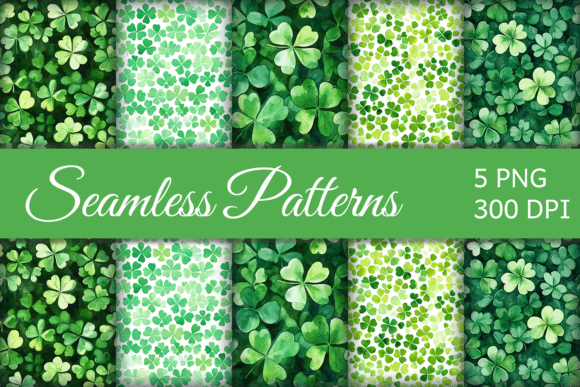
The collection features watercolor seamless patterns centered around the iconic four-leaf clover, a symbol deeply rooted in Irish culture and widely recognized as a harbinger of luck. The aesthetic leans toward organic, hand-painted textures rather than rigid geometric shapes, giving each piece a soft, approachable, and premium feel. This stylistic choice makes the patterns particularly effective for brands aiming to convey warmth, tradition, or natural elegance during their St. Patrick’s Day marketing campaigns. By utilizing these pre-made backgrounds, designers can bypass the time-consuming process of creating custom vector graphics from scratch, allowing them to focus on layout, copy, and overall brand strategy.
Visual Characteristics and Design Appeal
At the core of this asset pack is a distinct artistic direction. The watercolor technique introduces subtle variations in opacity and edge softness, mimicking the unpredictable nature of real paint on paper. When applied to the four-leaf clover motif, this results in a pattern that feels alive and textured rather than flat or digitally sterile. The color palette typically revolves around rich emerald greens, often complemented by hints of gold, white, or soft pastels depending on the specific variation within the set. This chromatic harmony ensures that the patterns do not overwhelm other design elements but instead serve as a sophisticated backdrop.
From a technical standpoint, the inclusion of 300 dpi resolution at a size of 4000 × 4000 pixels is a significant advantage for commercial use. High resolution is non-negotiable when preparing files for large-format printing, such as banners, posters, or textile rolls. Low-resolution images often pixelate or appear blurry when scaled up, undermining the perceived value of a product. With these dimensions, users have ample flexibility to crop sections for smaller applications like social media avatars or email headers without sacrificing clarity. The PNG format further enhances utility by supporting transparency, allowing the pattern to blend seamlessly over different background colors or photographic elements.
The "seamless" nature of these patterns is crucial for scalability. A true seamless tile repeats invisibly, meaning designers can stretch the image to cover any surface area—whether it’s wrapping paper, a phone case, or a website background—without visible breaks or awkward interruptions. This continuity is what separates professional-grade design assets from amateur attempts, ensuring that the final output looks polished and intentional.
Practical Applications Across Industries
The versatility of St.Patrick’s Day Patterns PNG extends far beyond simple decoration. Because the patterns are provided as high-quality digital downloads, they fit into various workflows for entrepreneurs, marketers, and hobbyists alike. One of the most popular applications is in the realm of printable products and physical goods. Small business owners selling on platforms like Etsy or Shopify can easily integrate these designs into mockups for mugs, pillows, tote bags, and phone cases. The watercolor texture adds a layer of perceived craftsmanship that appeals to consumers looking for unique, artisanal-style gifts.
In the realm of editorial and publishing, these patterns serve as excellent background elements for greeting cards, party invitations, and event posters. The organic feel of the clover motifs pairs well with serif fonts for a classic look or sans serif fonts for a modern twist. For bloggers and content creators, using these patterns as featured images or section dividers can significantly boost click-through rates during the holiday season. The visual break they provide helps guide the reader’s eye through long-form articles, improving readability and engagement.
For web designers and app developers, incorporating these assets into landing pages dedicated to spring sales or St. Patrick’s Day promotions can create an immersive user experience. Instead of relying on stock photography that may feel generic, a custom-tiled background provides a branded environment that feels curated. Similarly, in packaging design, these patterns can be used to create limited-edition labels or boxes, helping consumer packaged goods stand out on crowded retail shelves. The ability to reuse these assets across multiple touchpoints—from social media graphics to physical packaging—ensures brand consistency throughout the campaign.
Strategic Implementation and Best Practices
While the assets themselves are high-quality, their effectiveness depends largely on how they are integrated into a broader design system. When working with St.Patrick’s Day Patterns PNG, it is essential to consider contrast and hierarchy. Because the watercolor patterns contain detail and texture, pairing them with bold, legible typography is key. Avoid placing delicate script fonts directly over busy areas of the pattern where they might get lost. Instead, use solid color blocks or semi-transparent overlays to create clear zones for headlines and calls to action.
Evaluating project fit is another critical step. Not every brand identity aligns with the whimsical, traditional vibe of a four-leaf clover pattern. Luxury brands seeking minimalism might find the organic texture too distracting, whereas lifestyle, wellness, or heritage brands will likely find it highly compatible. Before committing to a full rollout, test the patterns in grayscale to ensure that the design holds up without relying solely on color. This practice helps verify that the composition has strong structural integrity.
Commercial licensing and usage rights should always be reviewed carefully. While these are digital downloadable products intended for broad application, understanding the scope of permitted use protects both the creator and the buyer. Typically, these assets allow for unlimited personal and commercial projects, but restrictions may apply regarding resale as standalone digital files. Always ensure that the final product incorporates significant original design work, transforming the pattern into a unique part of a larger creative vision rather than simply redistributing the raw file.
Finally, remember that actual colors may differ slightly based on monitor settings and print methods. Digital screens emit light, while printed materials reflect it. To mitigate discrepancies, always proof print a small sample before committing to a large production run. This minor precaution ensures that the vibrant greens and subtle watercolor gradients translate accurately to the final medium, preserving the integrity of the design. By treating these patterns as foundational building blocks rather than finished products, designers can unlock their full potential to create engaging, professional, and culturally resonant work.